
Spring clean-ups, tip runs and moving house all mean one thing: loaded trailers. A load that shifts or falls off is dangerous, and in Victoria you can be fined for a poorly restrained load even if nothing comes loose. Here’s how to tie a load down properly, using the national guide for light vehicles.
What the rules say
Transport Victoria says it is an offence to carry a load that is not properly restrained and could fall from your vehicle or trailer. You can be fined even if the load doesn’t come loose, and it is your job to work out the best way to restrain it.
The practical “how to” is the National Transport Commission’s Load Restraint Guide for Light Vehicles, which covers cars, utes, vans and trailers up to 4.5 tonnes GVM. Transport Victoria refers drivers to it.
How much restraint do you need?
The NTC guide says your restraint must stop the load moving under normal driving, including hard braking, swerving and rough roads. It sets these minimums, as a share of the load’s weight:
- Forwards: 80% (hard braking is the big one)
- Sideways: 50%
- Rearwards: 50%
- Upwards: 20% (bumps and rough roads)
So a 500 kg load needs restraint that can hold 400 kg trying to slide forward. Pushing the load hard up against the front of the trailer (the headboard) is one of the best ways to handle that forward force, as long as the headboard is strong enough.
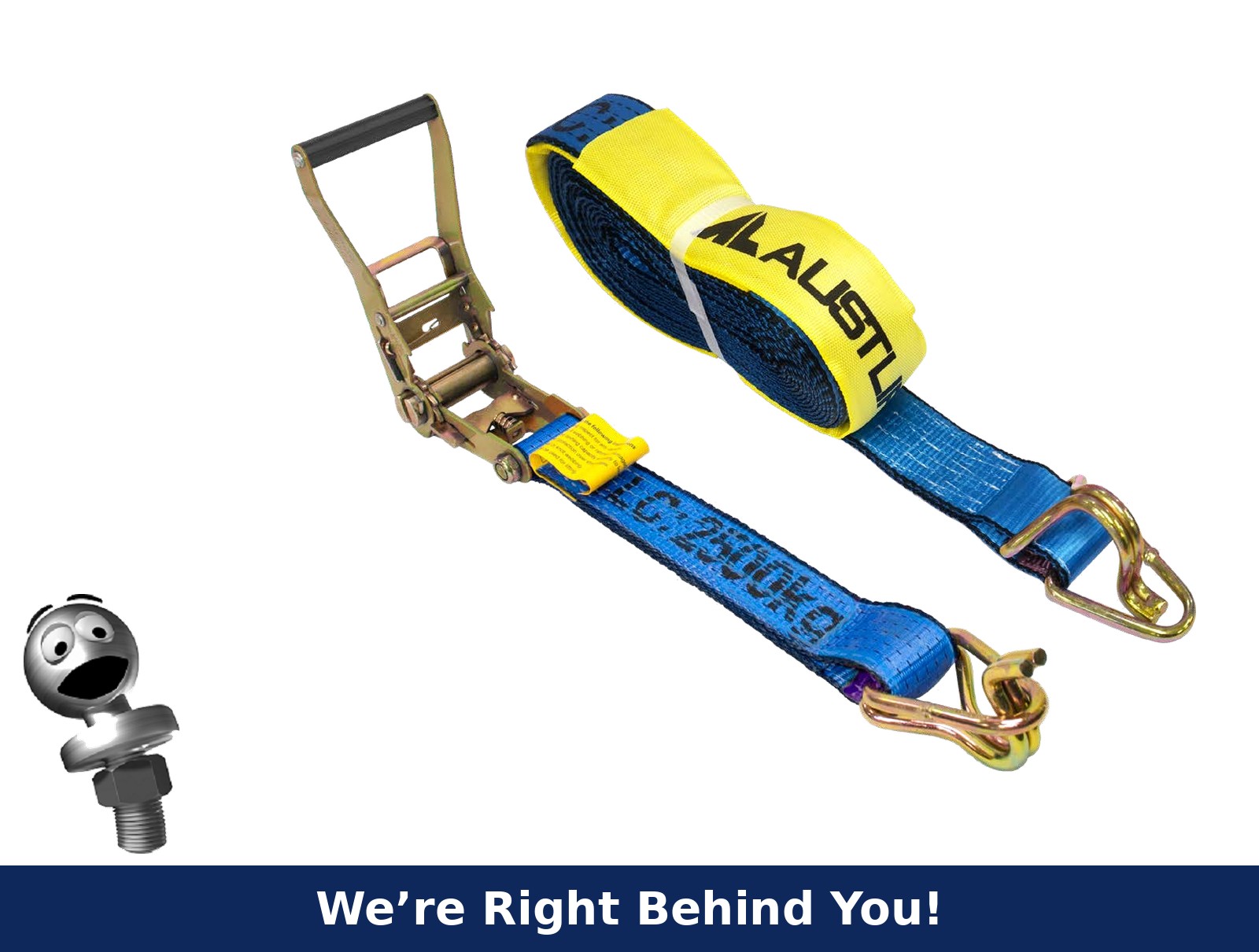
Use rated straps and read the label
Rated webbing straps show a lashing capacity (LC) on the label. That is the most the strap is designed to hold in use. Transport Victoria notes that straps meeting AS/NZS 4380:2001 are more effective than ropes and simpler to use.
- Go by the LC on the tag. Break strength is a much higher number and is not what the strap should hold.
- Don’t use straps that are cut, frayed, burnt or have damaged hooks or ratchets.
- Webbing stretches. The NTC guide says to check and re-tension straps during the trip.
- Ropes are only recommended for light loads.
Strap angle matters
A strap pulled down over the load works best when it is close to vertical. The flatter it runs, the less it holds the load down. From the NTC guide:
| Strap angle (from the trailer floor) | Effectiveness |
|---|---|
| 90° | 100% |
| 60° | 85% |
| 45° | 70% |
| 30° | 50% |
| 15° | 25% |
The guide’s minimum angle for effective restraint is 35°. On a low, wide load, put stable packing under it to get the angle up, or use more straps.
Nets and tarps
A cargo net can contain a load up to its rated capacity. An elastic trailer net is great for keeping light garden waste and rubbish in the trailer, but it is not a substitute for straps on anything heavy. Transport Victoria says nets, tarps and ropes are only suited to light loads.
Tarps are not a restraint on their own. Use them for weather or to stop light material blowing out, with the real restraint done by straps or a rated net.
Pack it so it stays put
- Heavy items low and towards the front, lighter items on top.
- Keep the centre of gravity low and close to the centre line of the trailer.
- Fill gaps so items can’t slide into each other. Bundle similar items together.
- Use anti-slip matting under smooth loads. The NTC guide warns against conveyor belt rubber.
- Tall items can tip. The guide says a load can tip forward if its length is less than 80% of its height, and sideways if its width is less than 50% of its height.
- If an item takes two people to lift, it needs to be tied down.
Strap to solid anchor points: rated lashing rings or tie-down points, not the light-gauge sides of a box trailer or the mudguards.
Loads that stick out
The NTC guide sets limits on how far a load can project. Sideways, no more than 150 mm past either side, and no more than 2.5 m total width. Forward, no more than 1.2 m. On a single-axle trailer, the rear overhang (measured from the axle) is the lesser of the front load area length or 3.7 m.
A projection that is hard to see, or that sticks out more than 1.2 m at the back, needs a warning: a brightly coloured flag at least 300 mm square by day, and a red light that can be seen from 200 m away at night.
Before you drive off
- Push, pull and rock the load. If it moves, add restraint.
- Check your trailer isn’t over its ATM (on the trailer plate) and that the vehicle can still steer and brake properly.
- Re-check straps after the first few kilometres and at every stop.
- A heavy load can push your headlights up. Check they aren’t dazzling other drivers.
- If something falls off and it’s unsafe to pick up, call 13 11 70.
FAQ
Can I get fined if my load didn’t fall off?
Yes. Transport Victoria says you can be fined even if the load doesn’t come loose. Penalties are higher for companies.
Is a trailer net enough for a tip run?
For light garden waste, a net that covers the load is usually the right tool. For heavy items like timber, bricks or appliances, use rated straps as well.
How many straps do I need?
It depends on the load’s weight, its shape and the strap angle. Add up the working lashing capacity, allowing for angle, and make sure it covers the 80% forwards, 50% sideways and 50% rearwards figures. When in doubt, use more straps.
What does LC mean on a strap?
Lashing capacity: the maximum load the strap is designed to hold in use. It’s shown on the strap’s tag.
Need ratchet straps, a trailer net or lashing rings? We stock them at 4 Ballarat-Carngham Rd, Alfredton. Call 1800 486 922.
We’re Right Behind You!