
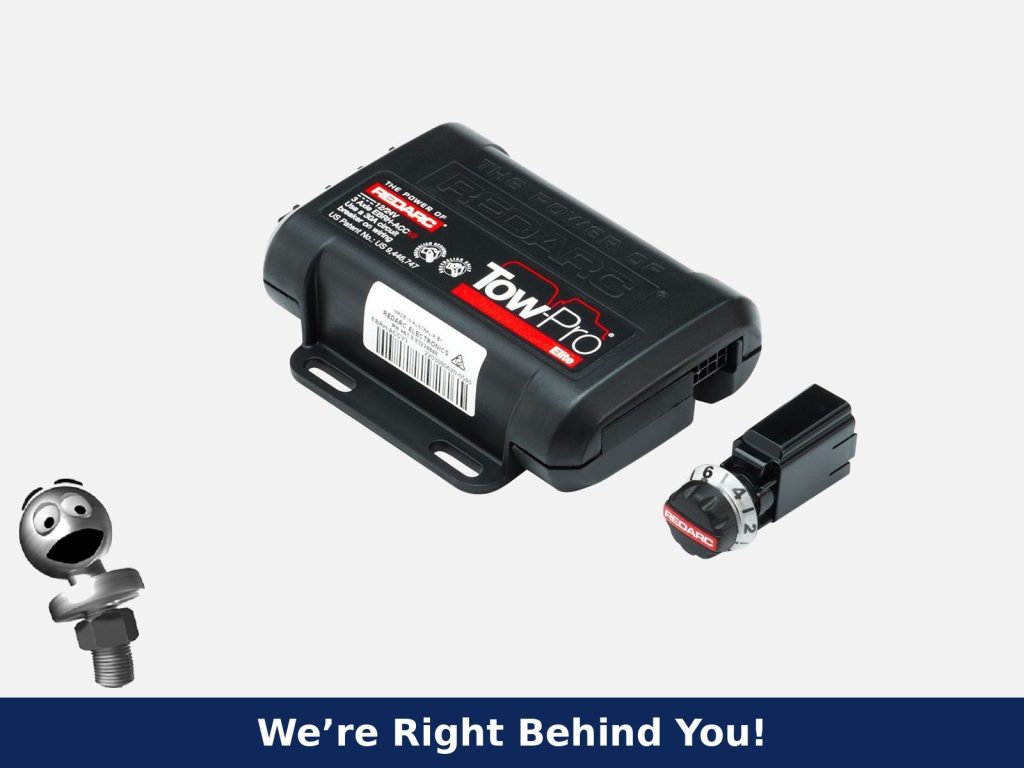
An electric brake controller is a small unit fitted in your tow vehicle that sends a signal to your trailer’s electric brakes, so the trailer brakes along with the car. If your trailer, caravan or float has electric brakes, you need one, because electric brakes can’t work without that signal. Under the national trailer standards, any trailer over 750 kg gross trailer mass (GTM) must have brakes, and over 2,000 kg GTM the brakes must work on every wheel and be controlled from the tow vehicle. That’s why you’ll find electric brakes and an in-cab controller on so many caravans, campers and horse floats.
What is an electric brake controller?
A brake controller sits in or under the dash. When you brake, it sends power through the brake circuit in your trailer plug to the trailer’s electric brakes. In the standard 7-pin and 12-pin trailer plugs, that’s pin 5, the blue “service brakes” wire (VSB1).
It also lets you set how hard the trailer brakes, to suit the load.
When does a trailer need brakes?
Trailer brake requirements in Australia come from Australian Design Rule 38/05 (Trailer Brake Systems) and Vehicle Standards Bulletin 1 (VSB1), the national code for trailers up to 4.5 tonnes ATM. Both set the thresholds by GTM:
- Up to 750 kg GTM: brakes aren’t required.
- Over 750 kg, up to 2,000 kg GTM: the trailer must have an efficient service brake system. Brakes may be fitted to one axle only. Over-run (override) brakes are allowed. Any other type, such as electric brakes, must be operated by a control signal from the tow vehicle.
- Over 2,000 kg GTM: brakes must operate on all wheels, and over-run brakes are no longer allowed, so the brakes must be controlled from the tow vehicle. The trailer also needs breakaway brakes that apply immediately if it comes off the car and stay on for at least 15 minutes.
Sources: ADR 38/05, clause 5 and VSB1 Revision 6, section 8 (Braking). VSB1 notes its braking section is under review, so always check the current version.
GTM or ATM: which number counts?
People often say “750 kg ATM”, but the braking rules use GTM. ATM (aggregate trailer mass) is the total weight of the trailer fully loaded, including the weight pressing down on the towball. GTM (gross trailer mass) is the weight carried by the trailer’s own axles when it’s hitched up and fully loaded. So GTM is ATM minus the towball download. Check your trailer’s plate or paperwork for its ratings.
Types of brake controller
Proportional
A proportional controller senses how hard the vehicle is slowing and applies the trailer brakes to match. REDARC describes the Tow-Pro Elite in proportional mode as sensing “the inertia of the braking vehicle”.
User-controlled
In a user-controlled mode, the driver sets a fixed level of trailer braking with the dial, regardless of how the vehicle is moving. REDARC pitches the Tow-Pro Elite‘s user-controlled mode for off-road control, and its proportional mode for highways and gravel roads.
Manual override
Pressing the override applies the trailer brakes only. It’s designed for times you need the trailer to brake without the car, such as helping correct trailer sway. It isn’t a replacement for your normal brakes (REDARC Tow-Pro Elite operating manual).
Trailer-mounted
Some systems, such as Elecbrakes, mount on the trailer instead of in the vehicle.
How to set an electric brake controller
Always follow your controller’s instructions. The general method from REDARC and Tekonsha is:
- Hitch up and check. Connect the plug, check the lights, and test the brakes at low speed every time you hitch up.
- Start low. REDARC suggests starting below level 5 on the Tow-Pro Elite and adjusting from there.
- Find a safe spot. Use a dry, level, sealed surface clear of traffic.
- Test at about 40 km/h. Tekonsha’s method is to apply the controller’s manual control fully at around 25 mph (about 40 km/h).
- Adjust. If the trailer wheels lock, turn it down. If braking feels weak, turn it up. Aim for strong braking just short of lock-up, with the trailer slowing at the same rate as the car.
- Re-check when the load changes.
Sources: REDARC Tow-Pro, Tekonsha Prodigy P3 instructions.
Fitted in Ballarat
We supply and fit electric brake controllers in our Alfredton workshop, including REDARC Tow-Pro Elite and Tekonsha. We can fit one with your towbar and wiring in the same visit, and set it up to suit your trailer. Tell us your vehicle and what you’re towing, and we’ll get you a price.
FAQ
Do I need a brake controller for a trailer under 750 kg?
Not if it’s unbraked. Brakes aren’t required up to 750 kg GTM. If it does have electric brakes, you need a controller to use them.
Can I tow a trailer with electric brakes without a brake controller?
No. Electric brakes need the controller’s signal to work. Without it, the trailer won’t brake when you do.
Does a trailer with over-run brakes need a controller?
No. Over-run brakes apply when the trailer pushes against its coupling as you slow down. They’re only allowed up to 2,000 kg GTM.
Is the 750 kg brake limit based on ATM or GTM?
GTM, the weight on the trailer’s own axles. See “GTM or ATM” above.
How often should I adjust my brake controller?
Whenever the load changes, and check the brakes at low speed every time you hitch up.
Can you fit a brake controller when you fit my towbar?
Yes. Mention it when you book and we’ll do the towbar, wiring and brake controller in one go.
This is general information only. Always check your vehicle’s and trailer’s ratings and the current standards.
Got questions about brake controllers? Call us on 1800 486 922 or visit us at Ballarat Trailers & Towbars, 4 Ballarat-Carngham Rd, Alfredton, Monday to Saturday.
We’re Right Behind You!